Background
Neglected tropical diseases (NTDs) are a collection of infectious illnesses that collectively affect about 1.5 billion people worldwide, disproportionately impacting communities facing poverty and limited access to healthcare. Nigeria bears the largest share of this burden in sub-Saharan Africa, accounting for roughly a quarter of the region’s NTD cases. More than 122 million Nigerians are at risk of contracting one or more NTDs.
Five priority NTDs—lymphatic filariasis, onchocerciasis, soil-transmitted helminthiasis, schistosomiasis, and trachoma—are targeted for elimination through preventive chemotherapy (PC). The World Health Organization (WHO) recommends annual or twice-yearly mass drug administration (MDA) campaigns to control and ultimately eliminate these diseases.
Aligned with WHO’s 2030 Road Map for NTDs, Nigeria has committed to eliminating PC-targeted NTDs by the end of the decade. Improving MDA coverage is a core component of the country’s national health strategy. The Federal Ministry of Health (FMoH) leads implementation efforts in collaboration with multiple non-governmental development organizations (NGDOs). One long-standing partner, Sightsavers, has worked with the FMoH since 1953 and has supported the delivery of more than 590 million NTD treatments across seven Nigerian states.
MDA strategies vary by disease. Treatments for lymphatic filariasis and onchocerciasis are distributed at the community level to all eligible residents, while schistosomiasis and soil-transmitted helminthiasis interventions typically focus on school-aged children through school- or household-based campaigns.
Since 2010, Nigeria has relied on DHIS2 (District Health Information Software 2) to manage national health data for programs such as malaria, tuberculosis, HIV/AIDS, and polio. However, PC-NTD data collection historically depended on paper-based records completed by community drug distributors. These records required multiple layers of manual aggregation before being digitized, leading to reporting delays and data quality issues—a challenge also seen in countries including Ghana, South Sudan, and the Democratic Republic of Congo.
In Nigeria, the combination of manual reporting and complex multi-partner coordination resulted in fragmented datasets, delayed access to information, and difficulty tracking drug stocks and campaign progress in real time.
Development and Implementation of a New Platform
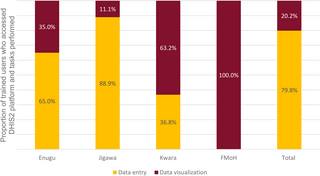
Between 2019 and 2021, the FMoH, in collaboration with Sightsavers, developed a new electronic data collection system to replace spreadsheet-based reporting. Modeled in part on a similar initiative implemented in Zimbabwe, the platform integrates PC-NTD reporting into DHIS2, enabling real-time data entry, monitoring, and analysis during MDA campaigns.
The primary goal of the new system was to centralize both historical and ongoing treatment data while allowing program teams to make informed adjustments as campaigns unfolded. This article outlines findings from the pilot phase and early scale-up efforts across different MDA contexts in Nigeria.
Key objectives of the initiative included:
- Evaluating whether the platform could consistently deliver timely and accurate data across diverse settings
- Assessing how real-time data could inform programmatic decision-making
- Examining its influence on government ownership and control of data
- Identifying facilitators and barriers to broader implementation
Insights and Challenges
Analysis revealed strong links between data ownership—defined by access, control, and use—and the study’s core research questions. State and local government officials reported being able to view and use MDA data as campaigns were underway, a major shift from previous practices where data access was delayed until after completion.
This improvement mirrors results seen in other health systems using DHIS2 and demonstrates the platform’s potential to transform NTD program management. However, limited internet connectivity emerged as a significant obstacle, echoing challenges documented in countries such as Bangladesh and Kenya. Connectivity costs and network reliability remain critical considerations for nationwide scale-up.
Participants also observed that improved data access led to better data quality. The DHIS2 dashboards enabled teams to quickly identify discrepancies, correct errors, and flag potential data manipulation—particularly at the state level—strengthening transparency and accountability.
Despite these gains, inconsistencies between DHIS2-reported treatment coverage and findings from independent surveys revealed lingering weaknesses. Some discrepancies fell outside expected ranges, underscoring the importance of triangulating data from multiple sources before making strategic planning decisions.
Stakeholders highlighted several practical benefits of the new system, including enhanced monitoring of MDA performance, improved planning for future campaigns, and more efficient drug inventory management. The ability to use data in near real time fostered greater collaboration and optimism among program teams.
Overall, respondents reported a notable increase in perceived data ownership, attributing this shift to structured access and control enabled by the DHIS2 platform. While enthusiasm for national expansion is strong, challenges related to staff workload, training needs, and digital infrastructure must be addressed.
As Nigeria prepares to expand the system further, the FMoH is encouraged to account for the diverse operational contexts of NGDO partners. A uniform approach may not be effective across all settings. Additional research in varied environments could strengthen understanding of how to optimize data quality, ownership, and use.
By addressing these challenges thoughtfully, Nigeria’s real-time NTD reporting platform has the potential to significantly improve program effectiveness and accelerate progress toward eliminating neglected tropical diseases by 2030.

Team Health Accessible
Health & Wellness Editorial Team
HealthAccessible editorial team delivers trusted, accessible, and evidence-based health information for everyone.